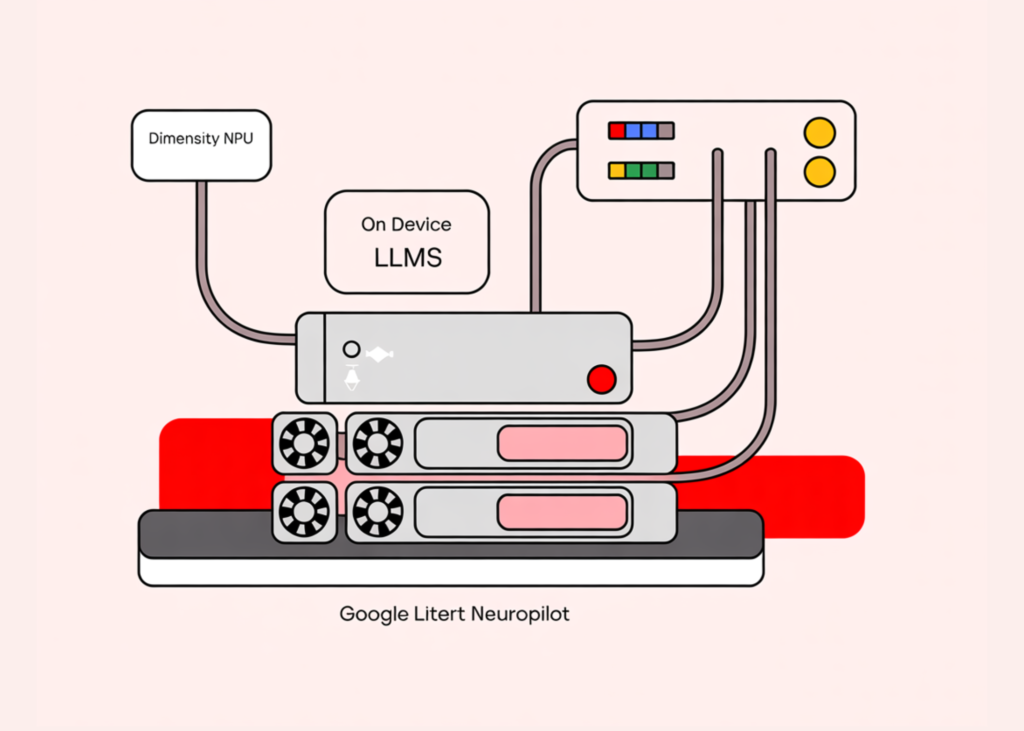
The new LiteRT NeuroPilot Accelerator from Google and MediaTek is a concrete step toward running real generative models on phones, laptops, and IoT hardware without shipping every request to a data center. It takes the existing LiteRT runtime and wires it directly into MediaTek’s NeuroPilot NPU stack, so developers can deploy LLMs and embedding models …
Continue reading Google LiteRT NeuroPilot Stack Turns MediaTek Dimensity NPUs into First Class Targets for on Device LLMs
Category:AI Tools
Zhipu AI Releases GLM-4.6V: A 128K Context Vision Language Model with Native Tool Calling

Zhipu AI has open sourced the GLM-4.6V series as a pair of vision language models that treat images, video and tools as first class inputs for agents, not as afterthoughts bolted on top of text. Model lineup and context length The series has 2 models. GLM-4.6V is a 106B parameter foundation model for cloud and …
Continue reading Zhipu AI Releases GLM-4.6V: A 128K Context Vision Language Model with Native Tool Calling
Jina AI Releases Jina-VLM: A 2.4B Multilingual Vision Language Model Focused on Token Efficient Visual QA
Jina AI has released Jina-VLM, a 2.4B parameter vision language model that targets multilingual visual question answering and document understanding on constrained hardware. The model couples a SigLIP2 vision encoder with a Qwen3 language backbone and uses an attention pooling connector to reduce visual tokens while preserving spatial structure. Among open 2B scale VLMs, it …
Continue reading Jina AI Releases Jina-VLM: A 2.4B Multilingual Vision Language Model Focused on Token Efficient Visual QA
Interview: From CUDA to Tile-Based Programming: NVIDIA’s Stephen Jones on Building the Future of AI

As AI models grow in complexity and hardware evolves to meet the demand, the software layer connecting the two must also adapt. We recently sat down with Stephen Jones, a Distinguished Engineer at NVIDIA and one of the original architects of CUDA. Jones, whose background spans from fluid mechanics to aerospace engineering, offered deep insights …
Continue reading Interview: From CUDA to Tile-Based Programming: NVIDIA’s Stephen Jones on Building the Future of AI
From Transformers to Associative Memory, How Titans and MIRAS Rethink Long Context Modeling

What comes after Transformers? Google Research is proposing a new way to give sequence models usable long term memory with Titans and MIRAS, while keeping training parallel and inference close to linear. Titans is a concrete architecture that adds a deep neural memory to a Transformer style backbone. MIRAS is a general framework that views …
Continue reading From Transformers to Associative Memory, How Titans and MIRAS Rethink Long Context Modeling
Cisco Released Cisco Time Series Model: Their First Open-Weights Foundation Model based on Decoder-only Transformer Architecture

Cisco and Splunk have introduced the Cisco Time Series Model, a univariate zero shot time series foundation model designed for observability and security metrics. It is released as an open weight checkpoint on Hugging Face under an Apache 2.0 license, and it targets forecasting workloads without task specific fine tuning. The model extends TimesFM 2.0 …
Continue reading Cisco Released Cisco Time Series Model: Their First Open-Weights Foundation Model based on Decoder-only Transformer Architecture
A Coding Implementation of a Complete Hierarchical Bayesian Regression Workflow in NumPyro Using JAX-Powered Inference and Posterior Predictive Analysis
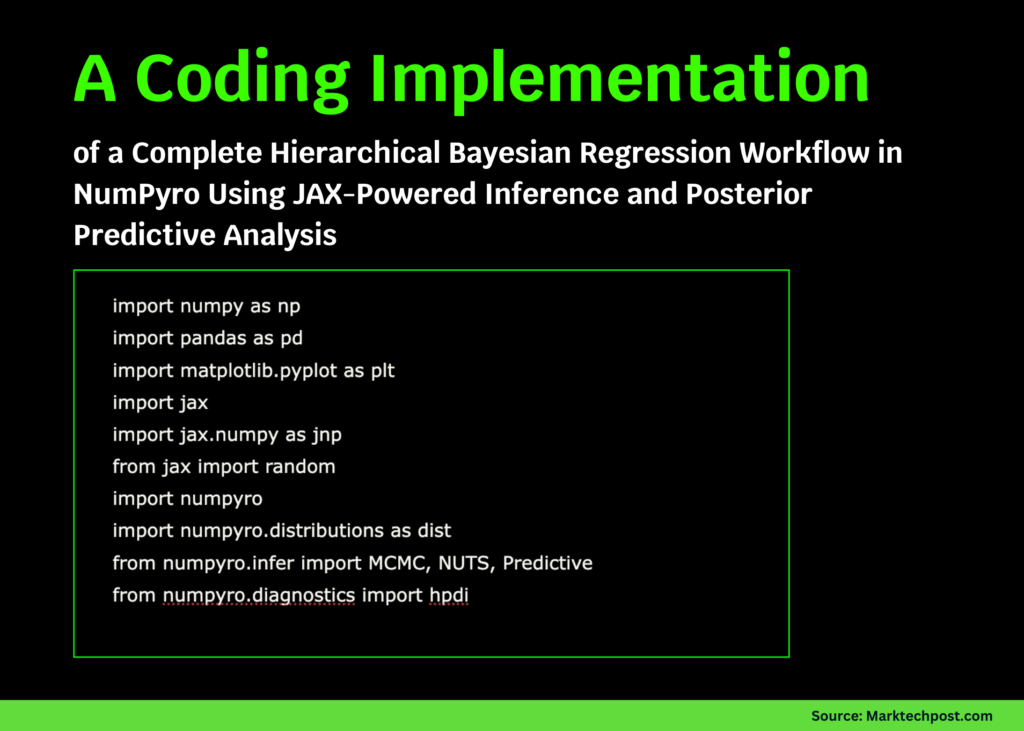
In this tutorial, we explore hierarchical Bayesian regression with NumPyro and walk through the entire workflow in a structured manner. We start by generating synthetic data, then we define a probabilistic model that captures both global patterns and group-level variations. Through each snippet, we set up inference using NUTS, analyze posterior distributions, and perform posterior …
Continue reading A Coding Implementation of a Complete Hierarchical Bayesian Regression Workflow in NumPyro Using JAX-Powered Inference and Posterior Predictive Analysis
Google Colab Integrates KaggleHub for One Click Access to Kaggle Datasets, Models and Competitions

Google is closing an old gap between Kaggle and Colab. Colab now has a built in Data Explorer that lets you search Kaggle datasets, models and competitions directly inside a notebook, then pull them in through KaggleHub without leaving the editor. What Colab Data Explorer actually ships? Kaggle announced the feature recently where they describe …
Continue reading Google Colab Integrates KaggleHub for One Click Access to Kaggle Datasets, Models and Competitions
Microsoft AI Releases VibeVoice-Realtime: A Lightweight Real‑Time Text-to-Speech Model Supporting Streaming Text Input and Robust Long-Form Speech Generation
Microsoft has released VibeVoice-Realtime-0.5B, a real time text to speech model that works with streaming text input and long form speech output, aimed at agent style applications and live data narration. The model can start producing audible speech in about 300 ms, which is critical when a language model is still generating the rest of …
Continue reading Microsoft AI Releases VibeVoice-Realtime: A Lightweight Real‑Time Text-to-Speech Model Supporting Streaming Text Input and Robust Long-Form Speech Generation
How We Learn Step-Level Rewards from Preferences to Solve Sparse-Reward Environments Using Online Process Reward Learning
In this tutorial, we explore Online Process Reward Learning (OPRL) and demonstrate how we can learn dense, step-level reward signals from trajectory preferences to solve sparse-reward reinforcement learning tasks. We walk through each component, from the maze environment and reward-model network to preference generation, training loops, and evaluation, while observing how the agent gradually improves …
Continue reading How We Learn Step-Level Rewards from Preferences to Solve Sparse-Reward Environments Using Online Process Reward Learning