
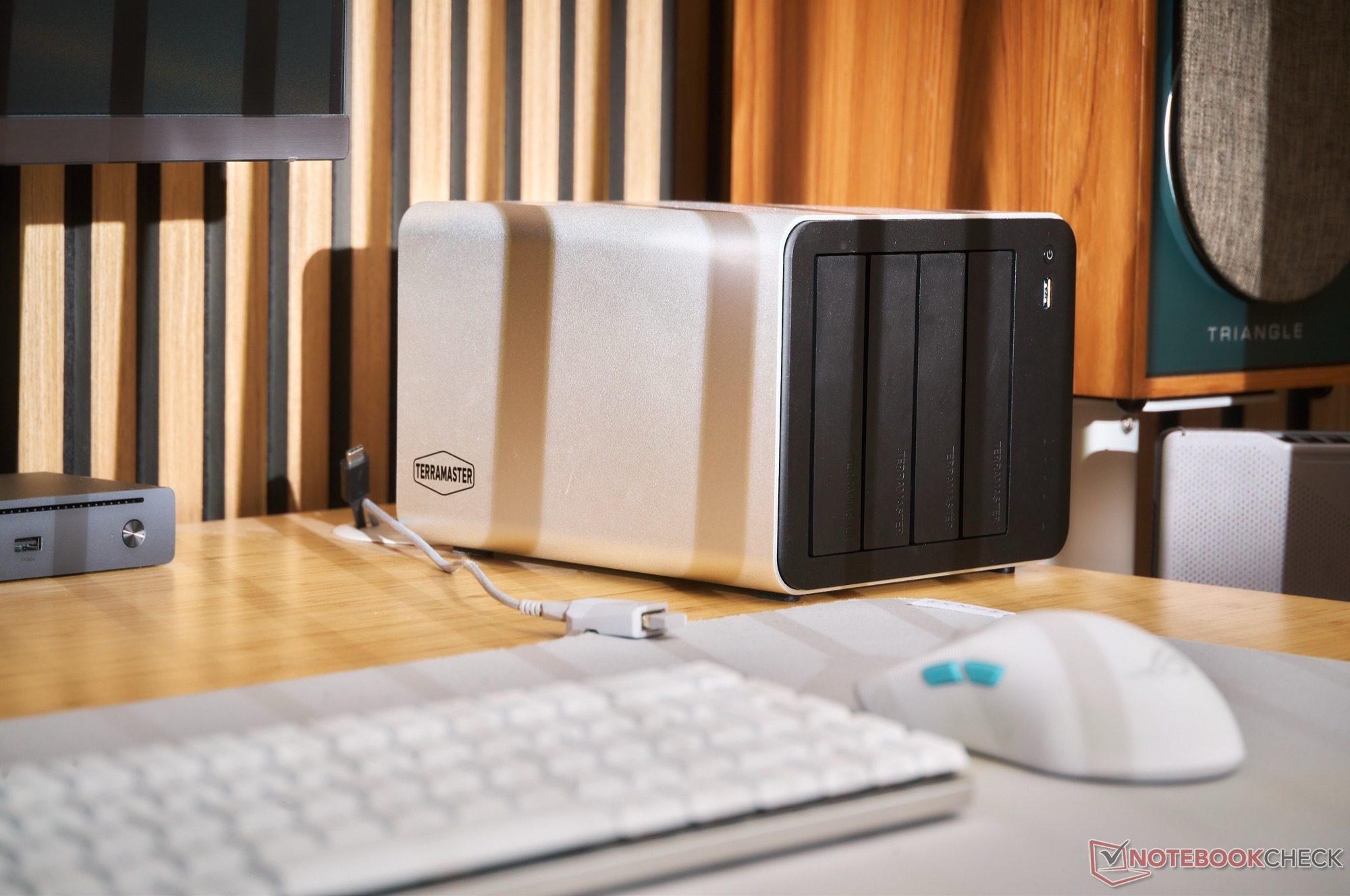
Four drive bays are almost standard for a NAS in this price class. What sets the TerraMaster F4-425 Plus apart is that it doesn’t stop at one or two M.2 slots, but offers three. This allows the SSDs to run in a RAID 5 configuration, so the system can keep operating without data loss even if one of the drives fails.
The HDDs and SSDs form two separate storage pools, which makes sense given their different speeds. Each SSD is connected via PCIe 3.0 x1, limiting read and write speeds to about 1 GB/s. Even entry-level SSDs can saturate that connection, and since the NAS is capped at roughly 1.25 GB/s over its two 5-Gbps LAN ports, the modest PCIe bandwidth isn’t a meaningful drawback in real-world use.
The USB selection is also impressive for this price. TerraMaster includes three USB-A ports and one USB-C port, all rated at 10 Gbps. This makes it easy to integrate external drives into the network through the F4-425 Plus, for example to use a USB hard drive for automated Time Machine backups.
Altogether, the system layout allows storage to grow gradually: start with one or two HDDs, expand to three or four, then add capacity through the M.2 SSDs and external drives as needed. In testing, TOS 6 handled this cleanly. It managed a single HDD without issue, then mirrored it to a second drive in RAID 1, and later expanded the array to RAID 5 with a third HDD – a process that took more than 24 hours with 6 TB drives. The NAS supports up to 144 TB in total, using four 30 TB HDDs and three 8 TB SSDs.

Comments